
Collegial conferences
To create friendly academic conferences where academicians and professionals present research findings, discuss novel ideas, build knowledge networks and share their expertise in an atmosphere of mutual trust and consideration.
Established in 2009, the Nepalese Academy of Management encourages management research, education and the dissemination of knowledge relevant to management practice locally, regionally and globally.
The Nepalese Academy of Management (NAM) is a professional association for scholars and professionals dedicated to creating and disseminating knowledge in all the disciplines required for managing organisations. Its members are scholars at colleges, universities and research institutions, as well as practitioners with scholarly interests from business, government and not-for-profit organisations.
The Academy is independent and not-for-profit. It places strong emphasis on an interdisciplinary approach, theoretical pluralism and research across management, economics and the social sciences, including entrepreneurship and economic development.
To pursue its aims the Academy organises international conferences, workshops, doctoral consortia and faculty development programmes, publishes a peer-reviewed journal and conference proceedings, and takes part in cross-cultural research with universities and scholarly associations abroad.
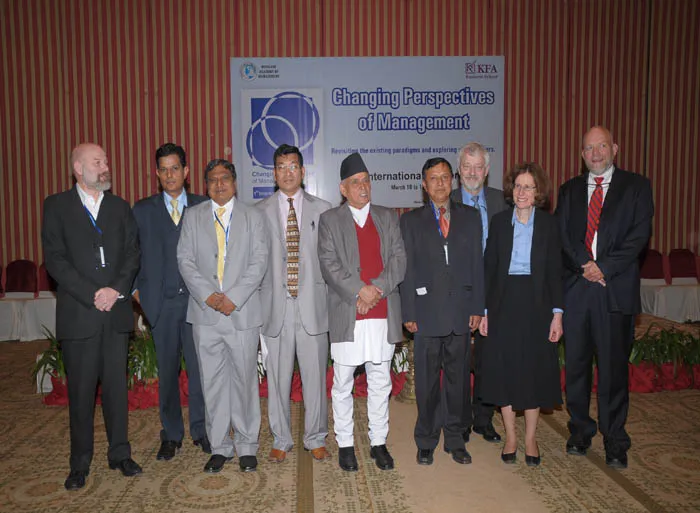
The objective of the Academy is to advance research, knowledge and education in organisation and management studies. It pursues that objective by:
Nurturing the development of knowledge locally, regionally and globally, and ensuring wider appreciation and acceptance of knowledge.
Providing a forum for the presentation and publication of scholarly research, and for the exchange of ideas and experience.
Facilitating international collaboration and network-building for research and development, which gives scholars and practitioners from around the globe opportunities for professional development.
Promoting the development of research capabilities and educational activities that contribute to intellectual and operational leadership in the field.
Offering assistance to young scholars and students to attend conferences and present their papers.
To create friendly academic conferences where academicians and professionals present research findings, discuss novel ideas, build knowledge networks and share their expertise in an atmosphere of mutual trust and consideration.
To facilitate discussion across business, social and development-related disciplines by both national and international scholars and practitioners.
To promote an experience in which all cultures, ethnicities, viewpoints, values and beliefs are welcome and respected.
To develop the competencies needed to meet the demands of the century globally, regionally and locally.
Founded in Kathmandu as an independent, not-for-profit association, with Prof. Dev Raj Adhikari as Founding President and Dr. Dhruba Kumar Gautam as Founding Secretary.
Changing Perspectives of Management, with KFA Business School: some 200 delegates from 33 countries. The conference issued the Kathmandu Declaration 2011.
Reshaping Organizations to Develop Responsible Global Leadership. The first issue of The International Journal of Nepalese Academy of Management is released.
A Doctoral Consortium and Faculty Development Programme, the first of its kind in Nepal, is held with the Society for the Advancement of Management Studies (UK).
Transforming Management System for Innovation, Development and Governance: 350 delegates and 124 research papers.
Knowledge Transfer and Transformation, held jointly with the 14th conference of the International Federation of East Asian Management Associations: 450 scholars from 35 countries.
A conference on knowledge discourse, organised jointly with IFEAMA and Nihon University at Nihon University, Tokyo.
Webinars and online meetings bring scholars and practitioners together to discuss COVID-19 and its consequences.
The Academy is a member association of IFSAM and IFEAMA and has worked with universities and learned societies in Asia, Europe and North America.